
Volume 1 | Issue 1
October 2024

Designing Leadership Teams Built for Continuous AI Change
Self-limiting beliefs
and self-imposed
mental barriers might
be holding you back
Most AI and digital transformations don’t fail because the technology isn’t ready—they fail because leadership teams aren’t. As a leader facing perpetual change, your top team must shift from executing projects to stewarding an always-on transformation baseline, blending strategy, tech fluency, change mastery, and cultural alignment.
Continuous Transformation as the New Baseline
Forget one-off projects with tidy start and end dates. Today’s reality demands leadership teams wired for continuous adaptation—handling AI disruptions, hybrid dynamics, and growth pressures as the default state. Effective teams treat transformation like breathing: deliberate, relentless, and embedded in how they operate daily. They overcome inertia by naming it early—insight, psychological, or action gaps—and building collective muscle to push through.
Today's reality demands leadership teams wired for continuous adaptation—handling AI disruptions, hybrid dynamics, and growth pressures as the default state. Effective teams treat transformation like breathing: deliberate, relentless, and embedded in how they operate daily.
Complementary Capabilities Your Team Needs
No single leader can master it all. Transformation-ready C-suites combine strengths across five pillars:
Strategy and foresight: Spotting AI opportunities amid volatility, not just reacting.
Digital fluency and AI literacy: Comfort with tech stacks, AI ethics, and tools—not coding, but guiding rollout with confidence and spotting value gaps.
- Change leadership: Mobilizing people through uncertainty with clear narratives and early wins.
- Design thinking mindset: Embracing empathy, iteration, and experimentation to solve human-tech challenges collaboratively.
- Culture stewardship: Fostering behavioral agility over functional silos, where the team acts as “first team” above departments.
Research shows traditional experts become high-impact players by prioritizing enterprise success over solo wins—think team players who deliver tomorrow’s right mix, not just today’s results.
No single leader can master it all. Transformation-ready C-suites combine strengths
What These Teams Do Differently
They align on clear targets from day one, secure full buy-in (making sure to engage with the silent resisters), and stack quick wins to build momentum—mirroring McKinsey’s digital playbook. Start with shared purpose: “What must change, and why now?” Then enforce collective accountability through norms like co-creation, productive debate and unified decisions. Extend influence downward by activating an “extended transformation team” of key leaders who bring fresh skills and perspectives.
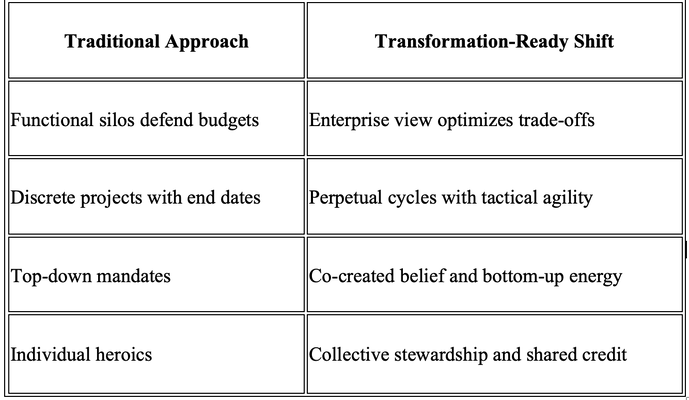
enforce collective accountability through norms like co-creation, productive debate and unified decisions.
Start with "I" and "We"
Individual growth fuels team strength. Each leader commits to inner work—building personal resilience and agility under pressure. At the “We” level, codify team norms: regular sensemaking sessions, decision habits that favor speed with alignment, and rituals for celebrating adaptation. CEOs model this by inviting challenge and owning blind spots publicly.
Building It: Design Thinking, Coaching, and Digital Fluency as Accelerators
Digital fluency, design thinking and leadership coaching are the three engines: digital fluency brings comfort with leveraging technology for strategic advantage, design thinking equips teams to prototype AI-human solutions iteratively, starting with empathy for users and stakeholders, while coaching builds the personal habits to sustain it. Digital fluency programs particularly with those not so comfortable—hands-on AI literacy ladders, from basics to strategic oversight—help to further close the executive gap where 70% of teams still falter. Together, via offsites, extended activations, and metrics on belief alignment, these shape teams that don’t just manage change—they thrive in it.
As the leader, ask yourself this week: Does our team have the mix, the norms, and the conviction to steward what’s next? The ones who do aren’t just surviving change—they’re built for it.
Sources
- https://www.russellreynolds.com/en/insights/reports-surveys/transformational-leadership-study
- https://www.russellreynolds.com/en/insights/articles/how-leadership-belief-powers-the-most-successful-transformations
- https://www.fastcompany.com/91313134/the-ai-gap-in-executive-leadership-teams
- https://www.vantedgesearch.com/resources/blogs-articles/executive-leadership-for-the-ai-era-embedding-digital-fluency-and-system
- https://juicebox.co.id/design-thinking-the-catalyst-for-digital-transformation/
- https://www.ideou.com/blogs/inspiration/ai-and-design-thinking
- https://www.russellreynolds.com/en/capabilities/how-do-i-boost-the-performance-of-leaders-and-teams
- https://pmc.ncbi.nlm.nih.gov/articles/PMC11762018/
- https://pmc.ncbi.nlm.nih.gov/articles/PMC10135561/
- https://www.russellreynolds.com/en/insights/articles/transformational-leaders-think-beyond-their-function
- https://www.youtube.com/watch?v=N1RxN23q230
- https://www.russellreynolds.com/en/capabilities/how-do-i-boost-the-performance-of-leaders-and-teams/development-and-transition
- https://www.designthinkersacademy.com/hongkong/course/2-day-ai-design-thinking-leadership-retreat-change-leadership/
- https://www.russellreynolds.com/en/insights/leadership-development
- https://www.fasa.net/Leader2Leader/leading-in-challenging-times
#StartWithI
#TransformationThatLasts
#DrivingEffectiveLeadership

Anu D’Souza runs Bricoleur Consulting, a leadership and transformation services advisory. A thought leader on AI era leadership and CX/ EX alignment, Anu has spent many years with companies like Unilever, Ogilvy and BBDO and has lived and worked in multiple cultures running teams across borders. Anu is also the author of ALIGNED Why CEOs need Company Brand Alignment in the Age of a Questioning Workforce. You can reach her on anu@bricoleurconsulting.com or book a call here.