
Volume 1 | Issue 1
October 2024

The AI Transformation Gap: Why Companies Are Investing More but Achieving Less
Self-limiting beliefs
and self-imposed
mental barriers might
be holding you back
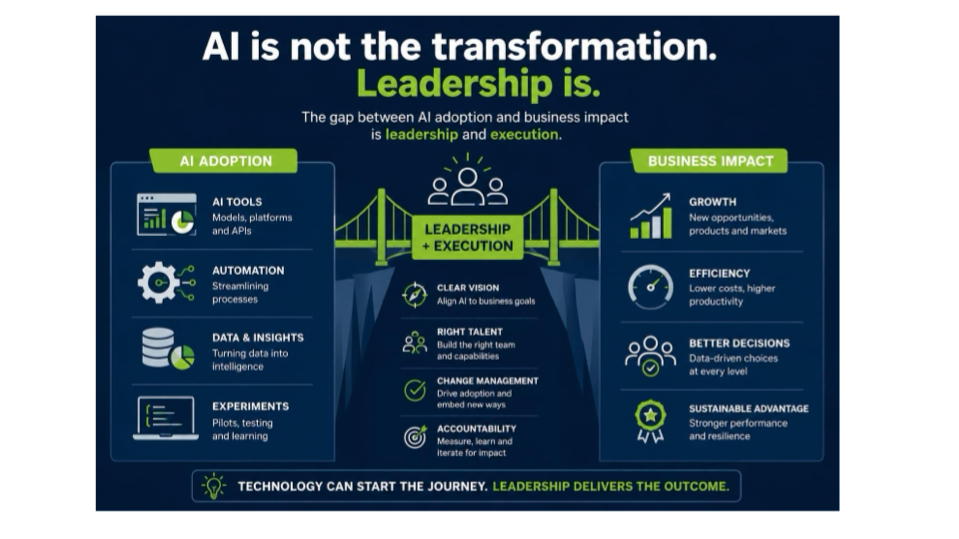
Organizations around the world are accelerating their investments in artificial intelligence. From AI platforms and automation tools to advanced analytics and intelligent systems, businesses are exploring how AI can improve efficiency, innovation, and competitiveness.
However, many organizations are discovering that having AI tools does not automatically lead to AI transformation.
The real challenge is closing the gap between AI adoption and measurable business impact.
Successful AI transformation is not about implementing more technology. It is about creating the right strategy, leadership alignment, and execution approach to turn AI investments into meaningful outcomes.
AI Pilots vs Enterprise Transformation
Many organizations begin their AI journey with pilot projects. These experiments often demonstrate promising results — improving individual processes, automating specific tasks, or generating new insights.
But moving from successful pilots to enterprise-wide transformation remains a challenge.
"The difference between an AI experiment and a true transformation lies in scale. Organizations must move beyond isolated use cases and integrate AI into the way they operate, make decisions, and create value."
This requires leaders to rethink workflows, redesign processes, and build an environment where AI becomes part of everyday business operations.
Leadership Accountability: The Critical Factor in AI Success
"AI transformation is not only a technology initiative. It is a leadership responsibility. Leaders must define a clear vision for how AI supports business goals and ensure that teams understand the purpose behind AI adoption."
The key questions leaders should consider:
- Are our AI initiatives connected to strategic business priorities?
- Do we have the right capabilities and skills within our teams?
- Are we preparing our people for new ways of working?
- How will we measure the impact of our AI investments?
Without strong leadership ownership, AI initiatives risk becoming disconnected projects rather than drivers of business transformation.
Measuring AI ROI: Moving Beyond Implementation
One of the biggest challenges organizations face is measuring the true value of AI.
"Success should not be measured only by the number of AI tools implemented or the number of projects launched. Instead, leaders should focus on measurable business outcomes."
- Increased operational efficiency
- Improved customer experiences
- Faster and smarter decision-making
- Enhanced employee productivity
- New opportunities for innovation
The goal is not simply to adopt AI.
The goal is to create measurable value through AI.
Moving From Experimentation to Execution
The next stage of AI transformation belongs to organizations that can successfully move from experimentation to execution.
This requires:
A clear transformation roadmap — connecting AI initiatives with long-term business objectives.
Strong leadership alignment — ensuring executives and teams move toward a shared vision.
Continuous learning and adaptation — building the skills needed for an AI-powered future.
A culture of innovation — encouraging teams to explore new possibilities while maintaining business focus.
The Leadership Question
AI will continue to reshape industries, business models, and the future of work.
The organizations that succeed will not simply be those that invest the most in AI. They will be the ones that know how to transform investment into impact.
The question for leaders is:
“Are we only adopting AI by building on existing ways of working, or are we strategically transforming our organization with AI?”
#TranformationThatLasts
Sources:
1. McKinsey & Company – The State of AI https://www.mckinsey.com/capabilities/quantumblack/our-insights/the-state-of-ai
2. Harvard Business Review – Artificial Intelligence & Leadership Insights https://hbr.org/topic/subject/artificial-intelligence
3. Deloitte – State of Generative AI in the Enterprise https://www.deloitte.com/global/en/services/consulting/articles/state-of-generative-ai-in-enterprise.html
4. MIT Sloan Management Review – Artificial Intelligence & Business Strategy https://sloanreview.mit.edu/topic/artificial-intelligence/

Anu D’Souza is the CEO of Bricoleur Consulting — insight-led leadership recruitment and transformation. She has spent her career at the intersection of business growth strategy, brands and leadership, working with and within companies including Unilever, Ogilvy and BBDO across multiple markets and cultures. Bricoleur works with senior leadership teams across APAC who are navigating AI and digital transformation — from readiness assessment through to placing the permanent and fractional leaders who make it stick. Anu is also the author of Aligned: Why CEOs Need Company Brand Alignment in the Age of a Questioning Workforce.
Connect with Anu:
insight@bricoleurconsulting.com · calendly.com/bricoleurconsulting/30min